A descriptive summary of the quarter, built on seven bi-weekly updates and three standalone analyses. It reports what happened and offers no recommendations.
In Brief
- Between June 30 and September 27, 2026, every bi-weekly update recorded at least one AI-related product release, partnership or acquisition among the tracked observability vendors.
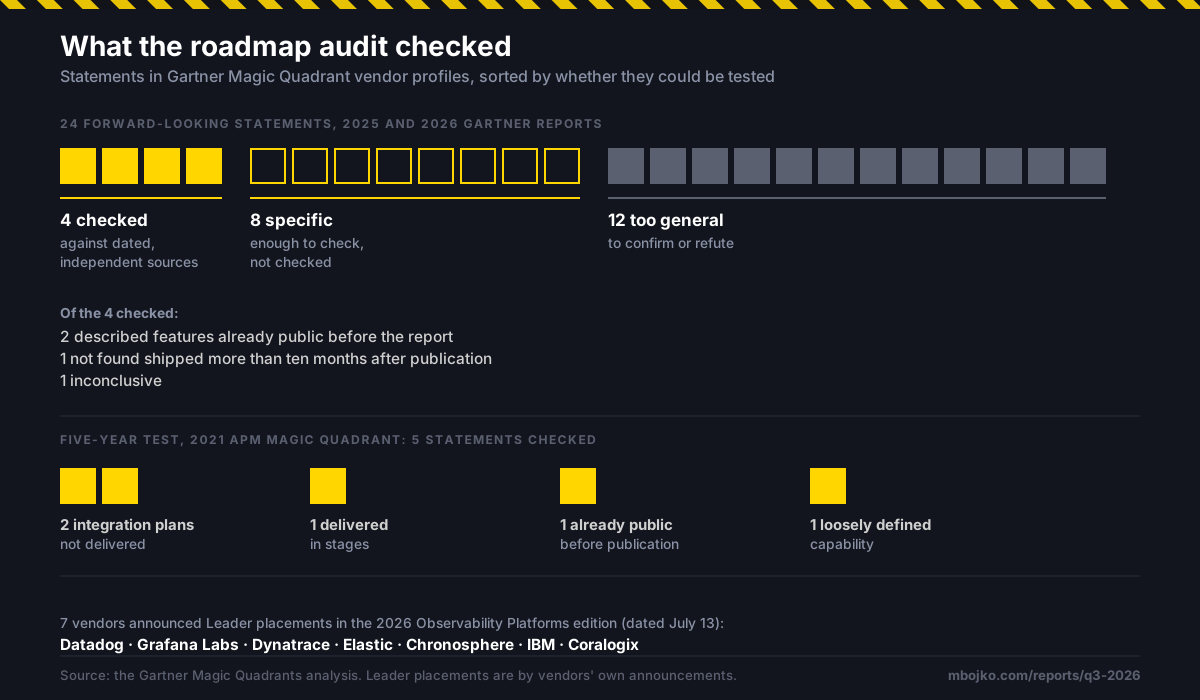
- Gartner's 2026 Magic Quadrant for Observability Platforms is dated July 13, and seven vendors announced Leader placements. An audit of 24 forward-looking statements in the 2025 and 2026 Gartner reports checked 4 against dated sources, and 2 of those 4 described features that were already public.
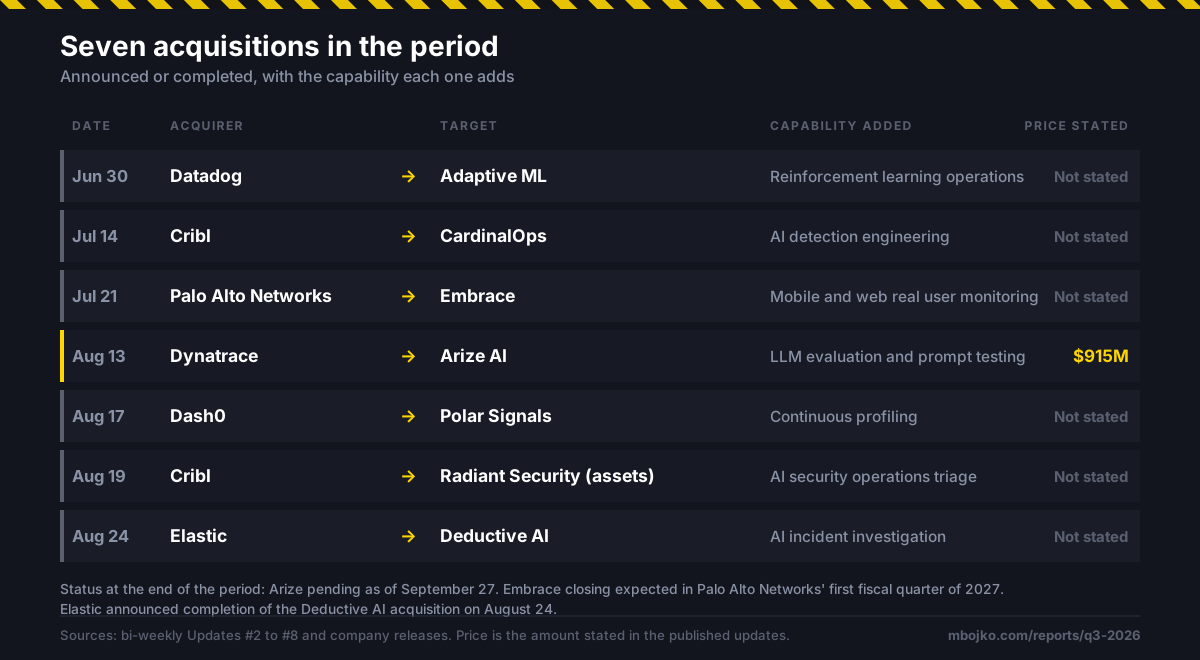
- Seven acquisitions were announced or completed in the period: Datadog and Adaptive ML, Cribl and CardinalOps, Palo Alto Networks and Embrace, Dynatrace and Arize AI, Dash0 and Polar Signals, Cribl and Radiant Security's technology assets, and Elastic and Deductive AI. Dynatrace's $915 million agreement for Arize is the only one with a price stated in the published updates.
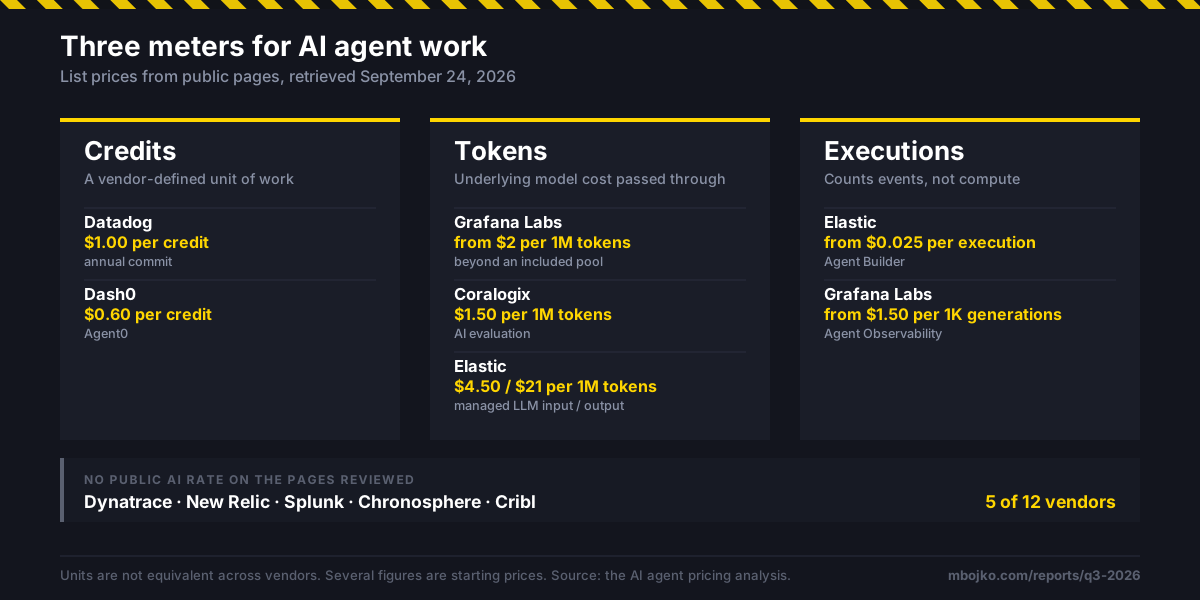
- Vendors began metering AI agent work between May and October 2026 in three different units (credits, tokens and executions), and five of the twelve vendors reviewed publish no AI rate.
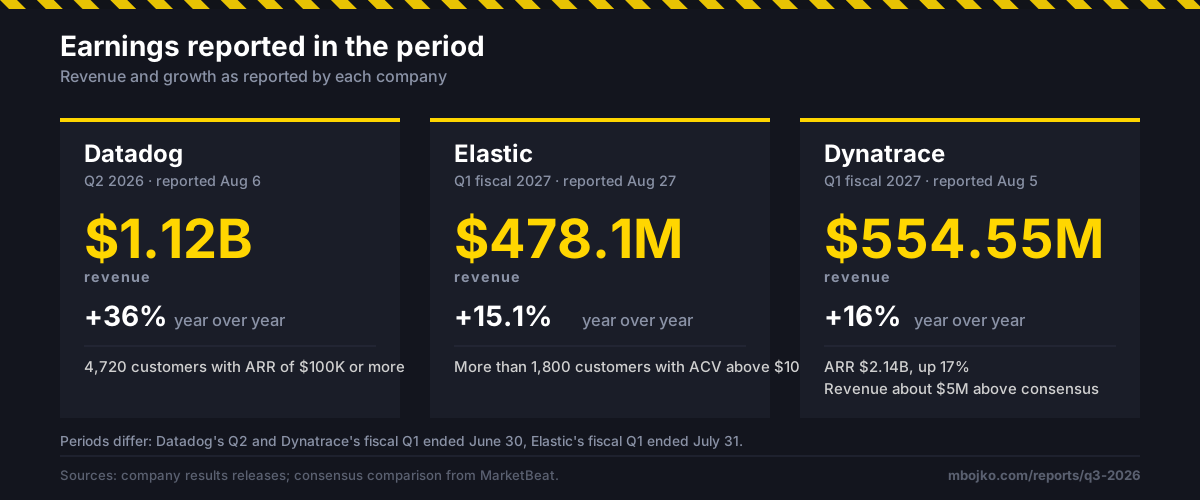
- Datadog, Dynatrace and Elastic each reported results in the period. Datadog's Q2 2026 revenue was $1.12 billion, up 36% year over year. Elastic's Q1 fiscal 2027 revenue was $478.1 million, up 15.1%. Dynatrace's Q1 fiscal 2027 revenue was $554.55 million, about $5 million above consensus, with annual recurring revenue of $2.14 billion, up 17%.
- Three items were open at the end of the period: the closing of the Arize deal, the closing of the Embrace deal, which Palo Alto Networks expects in its first fiscal quarter of 2027, and Snowflake's launch event for Observe agent observability on October 22.
At a glance
The Quarter in One Paragraph
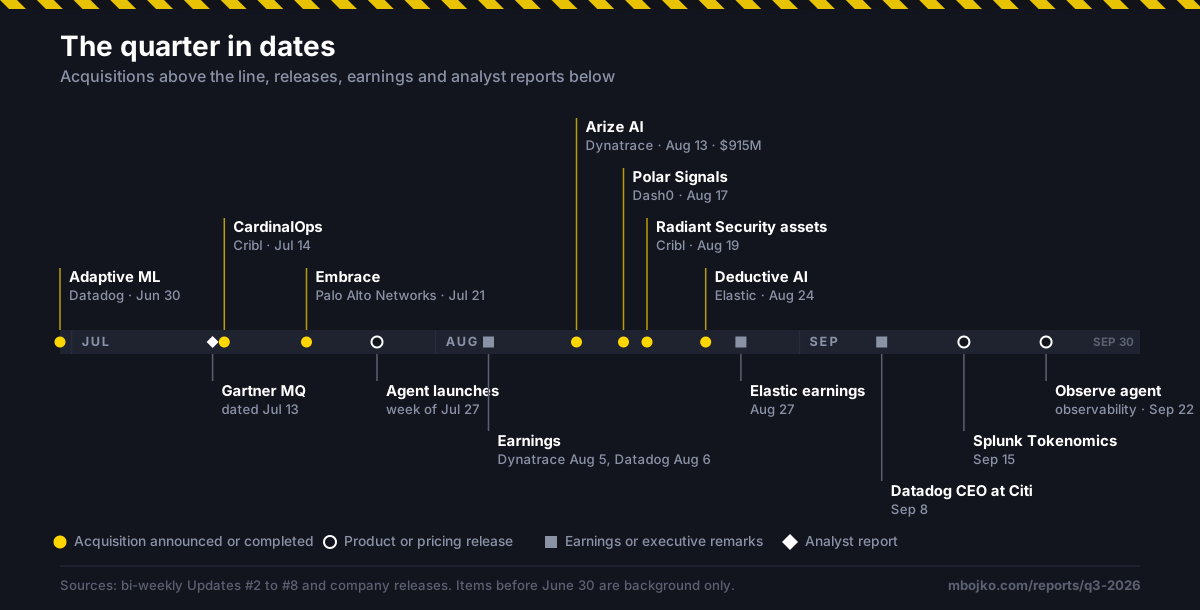
The period opened with Datadog's acquisition of Adaptive ML on June 30, a week after New Relic announced Autopilot and Ground Truth. In the update covering June 23 to July 13, Splunk's AI SRE in Observability Cloud also reached general availability. Gartner's Magic Quadrant for Observability Platforms followed in mid-July, and on July 21 Palo Alto Networks announced its intent to acquire Embrace, less than seven months after closing Chronosphere. The week of July 27 brought agent launches from Grafana Labs, Dynatrace and Dash0, and the week of August 3 brought earnings from Datadog and Dynatrace, with Elastic reporting on August 27. Three acquisitions landed between August 13 and 19 (Arize AI, Polar Signals and Radiant Security's technology assets), and Elastic announced completion of its Deductive AI acquisition on August 24. The two weeks after that produced news from Elastic only, and a ten-day check of company blogs and newsrooms across the thirteen tracked vendors confirmed the quiet. September turned to the cost of AI: Datadog's CEO described a move toward AI credits on September 8, Dash0 shipped coding-agent cost reporting on September 14, Splunk launched Tokenomics on September 15, and Observe by Snowflake announced agent observability with token and cost signals on September 22. Items dated before June 30, including Datadog's DASH 2026 launch on June 9 and 10, Splunk's CVE-2026-20253 patched on June 10, Elastic's 7% workforce reduction in late June and New Relic's June 23 announcements, appear in this report as background only.
Agent Releases Across Vendors
Agent capabilities appear in the collection in three forms, and several vendors shipped more than one.
Agents that act inside the platform
New Relic's Autopilot, announced on June 23, responds to alerts and scopes remediations, and Splunk's AI SRE had reached general availability by July 13. During the week of July 27, Grafana Labs shipped six tools in its first AI Week, including Assistant Investigations and Assistant Automations. Dynatrace announced an Autonomous SRE Agent, a Cloud SRE Agent and a no-code Agent Builder on one day, and Dash0 made Agent0 generally available, with read actions allowed by default and write actions off until enabled. Acquisitions added capability as well: Polar Signals brought AutoTune, which scans production code and opens pull requests, to Dash0, and Deductive AI brought a reinforcement-learning investigation engine to Elastic.
Observability of the agents themselves
Grafana launched Agent Observability. Cribl released an AI Observability app on August 3 that tracks token consumption and spend by model, application and department. Splunk announced Agent Observability with Tokenomics on September 15. Observe by Snowflake announced AI Agent Observability on September 22, with an optional OpenTelemetry-compliant SDK and online evaluations of production traffic. Dynatrace's agreement to buy Arize AI, whose product evaluates LLM quality before models reach production, adds pre-production coverage to a platform that already covers production.
Telemetry exposed to external agents
Coralogix and Grafana Cloud each released an MCP server, and New Relic's Ground Truth gives GitHub Copilot, Claude Code and AWS DevOps agents direct access to its data. Elastic announced on July 30 that OpenAI reasoning models would draw on Elasticsearch retrieval, and on September 3 that OpenAI GPT cyber models would run inside Elastic Security.
Adoption figures
Adoption figures come from vendor statements. On Dynatrace's August 5 earnings call, the CEO reported more than 1,000 customers observing AI and LLM workloads, up from roughly 850 the previous quarter, and more than 800 running operations with agentic capabilities, up from roughly 500. At Citi's conference on September 8, Datadog's CEO said its AI-native customer base had grown to roughly 750 from fewer than 100 about two years earlier, and that customers outside that group were growing in the high 20s percent range, up from about 18% a year earlier. Coverage of Splunk's .conf26 keynote reported that agent token consumption passed human consumption in February 2026 and now runs at about five times the human level. All three sets of figures come from vendor executives or from coverage of vendor keynotes, and the published updates cite no independent measurement of them.
Pricing
The pricing analysis records that none of the twelve vendors reviewed publishes a cost per resolved incident or per accepted fix. Published prices attach to activity such as credits, tokens or executions. Elastic began charging for Agent Builder and Workflows on May 1, and Grafana scheduled the start of metering for Assistant Investigations and Agent Observability for October 1.
Related Analyses
Three topics from the quarter have their own standalone analyses. Each summary below links to the full document.
Gartner Magic Quadrants and the roadmap audit
Gartner Magic Quadrants Analysis examines the forward-looking "roadmap" statements in vendor profiles of the 2025 Magic Quadrant for Digital Experience Monitoring and the 2026 Magic Quadrant for Observability Platforms, and checks a sample against the public record. The 2026 edition is dated July 13, 2026, and vendor announcements followed from July 15. By their own announcements, seven vendors were named Leaders: Datadog, Grafana Labs, Dynatrace, Elastic, Chronosphere, IBM and Coralogix. The analysis found 24 roadmap statements. Four were checked against dated, independent sources: two described features already public before the report, one had not been found shipped more than ten months after publication, and one was inconclusive. Twelve of the 24 were worded too generally to confirm or refute, and eight were specific enough to check but were not checked. A five-year test on the 2021 Magic Quadrant for Application Performance Monitoring checked five statements: two multi-year integration plans were not delivered according to Gartner's later text, one was delivered in stages, one was already public before publication, and one resolved into a loosely defined capability. The second part of the document lists the arguments about whether vendor spending influences placement, including two dismissed lawsuits, Gartner's disclosed revenue-threshold inclusion rule, the limits of Regulation FD and Gartner's published statement on open vendor briefings. It reaches no verdict on that question.
Read the full Gartner analysis →
Consolidation and acquisitions
Observability Market Consolidation and Acquisitions, 2017-2026 reviews thirteen acquirers and the deals behind them, using transaction prices, dates and outcomes from primary sources, SEC filings and financial press. The transactions range from Cisco's $3.7 billion purchase of AppDynamics in 2017 to Cisco's $28 billion Splunk acquisition, which closed on March 18, 2024, and Palo Alto Networks' $3.35 billion Chronosphere acquisition, which closed on January 29, 2026. Private equity appears as a separate buyer type: Francisco Partners and TPG acquired New Relic for $6.5 billion in 2023. The analysis sorts the transactions into three periods: feature completeness from 2017 to 2022, data and AI observability as a distinct category from 2022, and telemetry pipeline control from 2025 onward. For acquisitions old enough to assess, it records whether the acquired product remained an active line, and for recent ones it states that the outcome is too early to judge. It includes Cribl's CardinalOps and Radiant Security purchases from this quarter. Dynatrace's Arize agreement, Dash0's Polar Signals purchase, Elastic's Deductive AI deal, Datadog's Adaptive ML deal and Palo Alto Networks' Embrace agreement were announced in the same period and appear in the bi-weekly updates.
Read the full consolidation analysis →
How vendors price AI agents
How Observability Vendors Price AI Agents reviews the public price pages, documentation and earnings calls of twelve vendors, retrieved on September 24, 2026. It records three meters. Credits are used by Datadog ($1.00 per credit on an annual commit) and Dash0 ($0.60). Tokens are used by Grafana (from $2 per million beyond an included pool), Coralogix ($1.50 per million for evaluation workloads) and Elastic's managed LLMs ($4.50 and $21 per million input and output tokens). Executions and generations are used by Elastic (from $0.025 per Agent Builder execution) and Grafana's Agent Observability (from $1.50 per thousand generations). The analysis states that these units are not equivalent across vendors. Metering dates fall between May 1 and October 1, and Honeycomb's Pro plan rate rose from $1.30 to $3.00 per million events on July 1 while the plan gained features. Dynatrace, New Relic, Splunk, Chronosphere and Cribl publish no AI metering price on the pages reviewed. For Dynatrace, the CEO said on the August 5 call that agent activity drives DPS usage, and the CFO said no decision has been made to change the on-demand pricing mechanism. Datadog, Grafana, New Relic and Splunk document caps or alerts, and none of the vendors reviewed publishes a cost estimate for a specific task before it runs.
Read the full pricing analysis →
Scope and Method
The report covers June 30 to September 30, 2026 and draws on bi-weekly Updates #2 to #8, whose weekly data collection ran through September 27. Update #1 and other items dated before June 30 supply background only. Figures in this report were re-checked on October 4, 2026 against the company releases and coverage listed below. Where a figure or date differs from an earlier bi-weekly update, this report follows the primary source.
Sources
- Bi-weekly updates: #2, #3, #4, #5, #6, #7, #8.
- Datadog: second quarter 2026 results, Adaptive ML acquisition, June 30.
- Elastic: first quarter fiscal 2027 results, August 27 (syndicated copy), Deductive AI completion, August 24 (syndicated copy).
- Dynatrace: first quarter fiscal 2027 results, August 5, MarketBeat earnings report, consensus comparison, Arize acquisition, August 13, earnings call transcript, August 5.
- Palo Alto Networks: Embrace announcement, July 21 (syndicated copy).
- Cribl: CardinalOps acquisition, July 14.
- Gartner Magic Quadrant Leader announcements: Datadog, Grafana Labs, Dynatrace, Elastic, Chronosphere, IBM, Coralogix.
- Conference remarks: Datadog at Citi's Global TMT Conference, September 8, SiliconANGLE on Splunk .conf26 keynotes, September 16.
- Standalone analyses: Gartner Magic Quadrants Analysis, Observability Market Consolidation and Acquisitions, 2017-2026, How Observability Vendors Price AI Agents.