The past two weeks in observability were shaped by two forces running in parallel: the publication of the 2026 Gartner Magic Quadrant for Observability Platforms, which produced the predictable cascade of vendor press releases, and a more consequential piece of market structure news that arrived mid-week, Palo Alto Networks announcing its intent to acquire Embrace. Together, these signal that the market is simultaneously settling (the same six names keep appearing in the Leaders quadrant) and consolidating further around a small number of increasingly large platforms.
The Acquisition Machine: Palo Alto Networks Doubles Down
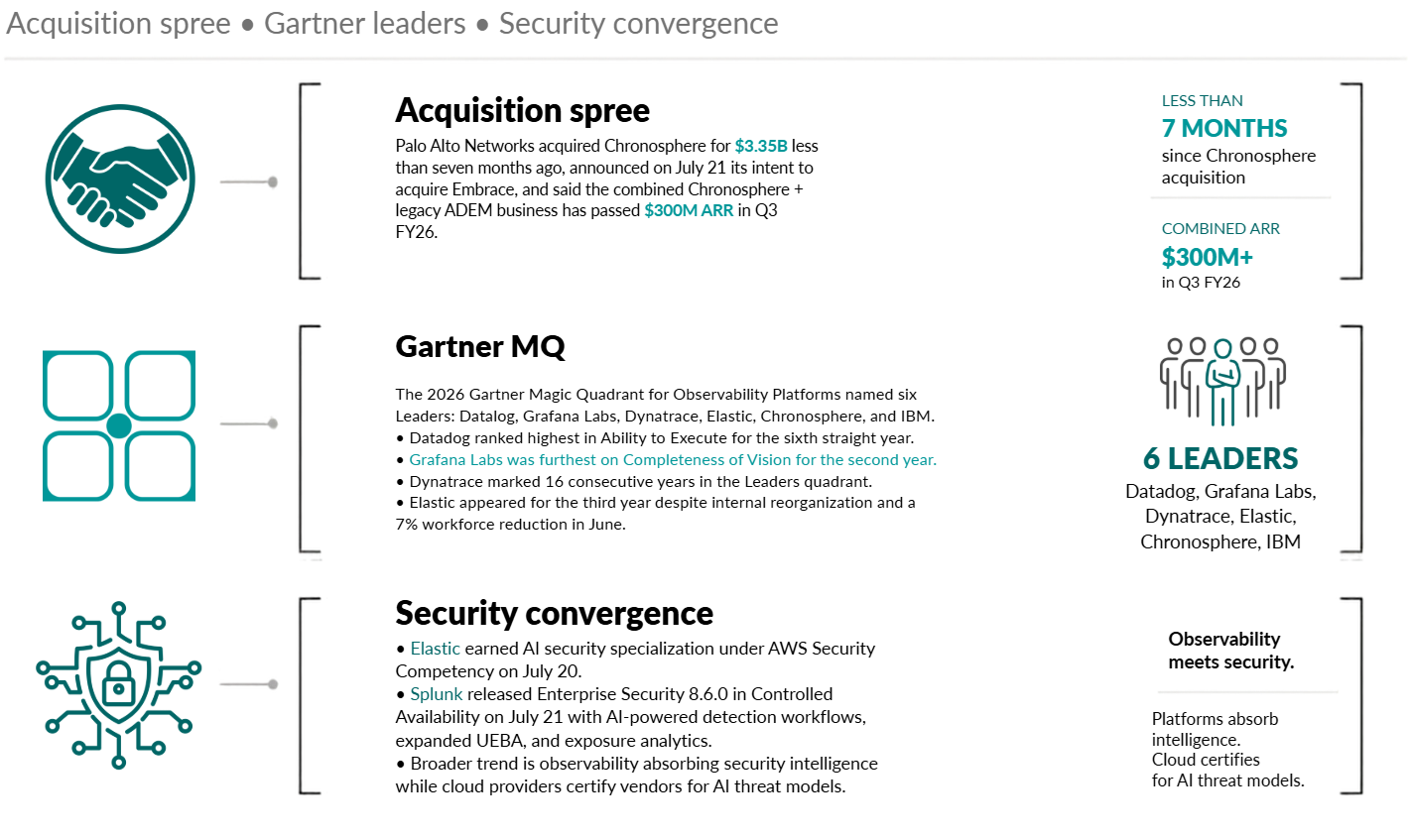
Less than seven months after closing its $3.35 billion acquisition of Chronosphere, Palo Alto Networks announced on July 21 its intent to acquire Embrace, a provider of mobile and web Real User Monitoring. The deal extends what is now a fast-growing observability platform: Palo Alto Networks disclosed that the combined business (Chronosphere plus the legacy ADEM team) has crossed $300M in annual recurring revenue in Q3 FY26. Embrace adds client-side telemetry to a stack that has been almost entirely focused on backend infrastructure, and the company is simultaneously building out Synthetics, proactive performance validation from globally distributed infrastructure, using its ADEM heritage.
The strategic direction is clear. Palo Alto is assembling a full-stack digital experience platform that spans backend traces (Chronosphere), user-facing telemetry (Embrace), proactive synthetic testing (ADEM/Synthetics), and security (Cortex). Whether it can execute on this integration simultaneously, at this pace, while also defending Chronosphere's cloud-native cost-control narrative is the open question. For enterprise buyers evaluating observability vendors this quarter, the platform is worth watching but carries meaningful integration risk.
The Gartner MQ: Vision vs. Execution, and Who Decided
The 2026 Gartner Magic Quadrant for Observability Platforms, published July 15, named six Leaders: Datadog, Grafana Labs, Dynatrace, Elastic, Chronosphere, and IBM. The positioning that matters most strategically is at the extremes. Datadog was placed highest in Ability to Execute for the sixth consecutive year, a signal that at scale and in competitive evaluations, it keeps winning deals. Grafana Labs was positioned furthest on the Completeness of Vision axis for the second year running, notable for a company built on open-source tooling, now claiming the broadest view of where observability is headed with its AI Observability stack for LLMs and its o11y-bench evaluation framework. Dynatrace claims 16 consecutive years in the Leaders quadrant, a streak no competitor can match, while Elastic appears for the third year, though its internal reorganization (CPO departure, 7% workforce reduction in June) sits in awkward contrast to an externally strong analyst showing.
The Gartner MQ is a lagging indicator, and most buyers already know this. What the 2026 report confirms is that the market has not meaningfully consolidated at the top: six leaders across a range of architectural bets, proprietary AI, open-source, security-converged, all still have credible claims.
Security-Observability Convergence Keeps Building
Away from the MQ noise, the week produced quieter but directionally significant moves on the security-observability boundary. Elastic obtained the AI security specialization under the AWS Security Competency on July 20, validating its capability to detect prompt injection, model misuse, and AI-agent threats, an increasingly important product surface as enterprises deploy agentic workloads. On July 21, Splunk released Enterprise Security 8.6.0 in Controlled Availability, adding AI-powered detection workflows, expanded UEBA, and exposure analytics, the most substantial ES release since Cisco's 2024 acquisition closed. Both moves point toward the same trend: observability tooling is absorbing security intelligence not as a separate product but as a capability layer, and cloud providers such as AWS are now actively certifying vendors on AI-specific threat models.
Storylines Building Toward Q3 Report
Five weeks into this collection cycle, three threads are mature enough to anchor the Q3 report: the Palo Alto / Chronosphere platform build-out, now spanning backend, frontend, synthetic, and security; Datadog's sustained execution leadership in competitive evaluations; and Elastic's simultaneous analyst recognition and internal restructuring, a tension that will resolve one way or the other by September. The Observe Inc integration into Snowflake remains a gap. The company has produced no public news since the acquisition closed in May and will need to reappear before Q3 closes.