The past two weeks delivered a sharper picture of where observability is heading than any analyst deck could. Earnings season proved the market is healthy, a wave of agentic product releases proved every vendor is racing to the same destination, and the security-meets-observability thesis got a second wind at Black Hat. The dominant thread running through all of it is autonomy: the idea that the right observability platform does not just show you what broke, it fixes it. Whether that ambition is real or marketing depends on which vendor is talking, but the investment behind it is real in every case.
Earnings Season: The AI Tailwind Is Real, but Uneven
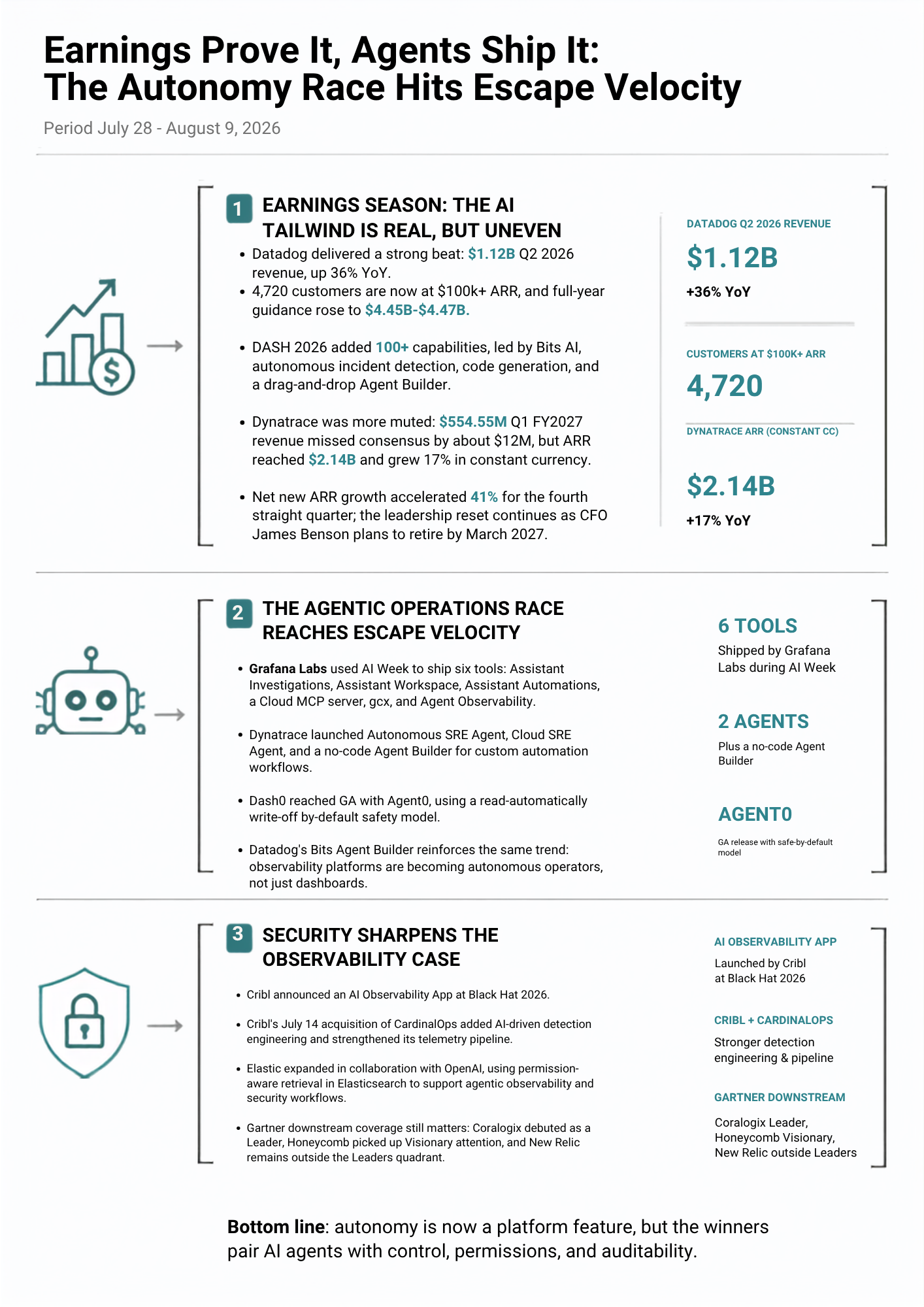
The week of August 3 brought the two most closely watched public observability companies to the table with very different report cards. Datadog delivered a decisive beat: $1.12 billion in Q2 2026 revenue, up 36% year over year, with 4,720 customers at $100k+ ARR and full-year guidance raised to $4.45-4.47 billion. This clears the air after a Bernstein downgrade in early July that flagged slowing demand signals. The demand is clearly there, and it is AI-driven. Datadog used the same earnings window to announce more than 100 new capabilities from DASH 2026, headlined by Bits AI, a suite covering autonomous incident detection, code generation, and a drag-and-drop Agent Builder for custom remediation workflows.
Dynatrace told a more complicated story. Revenue of $554.55M for Q1 FY2027 missed consensus by roughly $12M, and the company trimmed full-year guidance, but annual recurring revenue of $2.14 billion is growing at 17% in constant currency, and net new ARR growth accelerated to 41% for the fourth consecutive quarter. The Starboard-driven leadership reset that started in June is continuing: CFO James Benson will retire by March 2027, with a successor search underway. Shares initially dropped before recovering, and the underlying ARR momentum argues that Dynatrace's autonomous platform pivot is landing with its installed base even if it has not yet converted to revenue outperformance.
The Agentic Operations Race Reaches Escape Velocity
Every major observability vendor is now shipping AI agents as first-class platform citizens, not as beta footnotes. The week of July 27 was particularly dense. Grafana Labs ran its inaugural AI Week and shipped six distinct tools: Grafana Assistant Investigations for autonomous incident swarming, Grafana Assistant Workspace as a collaborative investigation canvas, Grafana Assistant Automations for alert-triggered remediation, a Grafana Cloud MCP server, gcx as infrastructure-as-code for dashboards and alerts, and Grafana Agent Observability for OTel-native coverage of AI systems. This was not a roadmap, it shipped, and the breadth signals that Grafana is building a full agentic operations layer rather than a chatbot bolted onto a dashboard.
Dynatrace announced its Autonomous SRE Agent and a Cloud SRE Agent for cross-cloud remediation on the same day, alongside a no-code Agent Builder that lets teams create custom automation workflows without engineering involvement. Dash0 reached general availability for Agent0, its autonomous agentic platform, with an explicit safety model where read actions run automatically and write actions stay off by default until explicitly allowed. From Datadog, the Bits Agent Builder extends a similar composability story. The race to own the "observability as autonomous operator" positioning is now clearly a multi-front competition, and the platforms that are winning are the ones pairing autonomy with an auditable, permissioned trail.
Security Sharpens the Observability Case
Cribl used Black Hat 2026 to announce capabilities that make the AI governance case concrete. Its new AI Observability App tracks token consumption, model spend, and adoption risk across teams and workloads, framing observability not just as an SRE tool but as a cost and compliance control for AI infrastructure. That framing arrives at a moment when enterprises are discovering their AI budgets are opaque, and it builds directly on Cribl's July 14 acquisition of CardinalOps, which added AI-driven detection engineering to its telemetry pipeline. The combination positions Cribl to control both the data pipeline and the detection logic layer, a path toward displacing legacy SIEM architecture rather than just feeding it.
Elastic's expanded collaboration with OpenAI, announced July 30, hit a similar note from a different angle. By grounding OpenAI reasoning models in Elasticsearch's permission-aware retrieval, the partnership targets agentic observability directly: SRE teams getting AI agents that can correlate telemetry and investigate root cause using enterprise knowledge, alongside agentic security operations. Elastic stock rose roughly 12% on the announcement, which suggests the market read it as more than a press-release partnership.
The 2026 Gartner Magic Quadrant, published in mid-July, is still generating downstream coverage. Coralogix debuted as a Leader backed by $200M in fresh Series F capital, and Honeycomb picked up a Visionary placement, though that specific positioning was not independently confirmed by enough sources to treat as settled. The more notable absence from the Leaders quadrant remains New Relic, which despite credible Autopilot and agentic announcements sits outside the Leaders circle heading into 2027.
Looking Back: Three Reports, One Throughline
Four updates in, a pattern is now hard to miss. Update #1 opened with Datadog's DASH 2026 launch and New Relic's SRE Agent, framed at the time as early moves. Update #2 added Datadog's Adaptive ML acquisition and New Relic's Autopilot GA, an acceleration. Update #3 covered Palo Alto Networks folding Embrace into its Chronosphere platform and a security-observability convergence building across Elastic and Splunk. This update shows the same handful of vendors, Datadog, Dynatrace, Grafana Labs, New Relic, shipping agentic capability nearly every single week for two months straight, with Q2 earnings now confirming the market is paying for it.
That raises the real question for the Q3 report: is this seven vendors racing toward the same autonomous-operations destination, or one market narrative that press releases are amplifying faster than actual enterprise adoption can follow? A second thread worth testing in Q3: the security-observability convergence (Palo Alto/Embrace, Cribl/CardinalOps, Elastic/OpenAI) is now three separate M&A or partnership moves deep. Is that consolidation into fewer, broader platforms, or fragmentation into competing full-stack bets that enterprises will need to choose between? Both questions deserve a harder look once a full quarter of data is in.