
Observability vendors spent the past two weeks buying their way into AI capabilities faster than they could have built them organically. Three acquisitions landed in this window, each targeting a different layer of the AI stack: evaluation, security operations, and continuous profiling. Underneath the deal-making, a quieter infrastructure shift is happening in parallel: telemetry data is becoming the context AI agents query directly, not just the output humans look at on dashboards.
The MCP Moment: Telemetry as Context for AI Agents
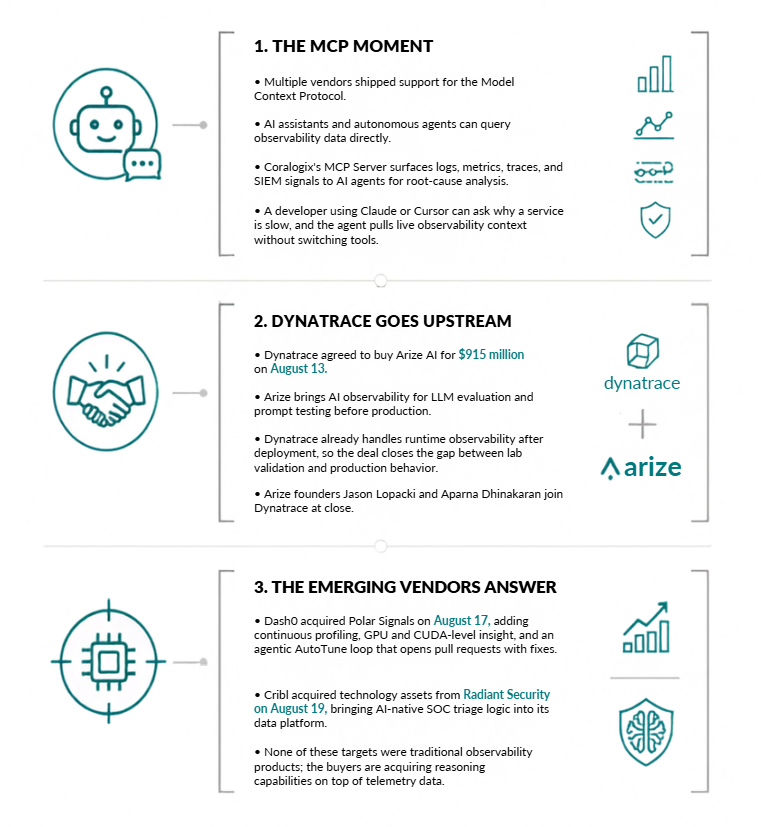
The structurally significant story of the fortnight is that multiple vendors shipped support for the Model Context Protocol, letting AI assistants and autonomous agents query observability data directly. Coralogix's MCP Server now surfaces logs, metrics, traces, and SIEM signals to AI agents for root-cause analysis. In practice, a developer using Claude or Cursor can ask why a service is slow and the agent pulls live observability context without switching tools, which shortens the loop between writing code and understanding its production behavior. For Coralogix, this turns its data platform into input for automated reasoning, not just output for human dashboards.
This pattern, telemetry as context rather than telemetry as display, is what connects the acquisitions below to something bigger than deal-making. Observability data is becoming the substrate agentic systems need to act, and the fortnight's biggest purchases are all bets on who controls that substrate.
Dynatrace Goes Upstream: The Arize Acquisition
Dynatrace agreed to buy Arize AI for $915 million on August 13, its largest and clearest AI bet yet. Arize built tooling for evaluating LLM quality and testing prompts before models reach production. Dynatrace already handles what happens after deployment. The combination closes the gap between confirming a model works in the lab and confirming it behaves correctly in production. Arize's founders, Jason Lopatecki and Aparna Dhinakaran, join Dynatrace at close, with Lopatecki reporting directly to CEO Rick McConnell.
The bet is that enterprise customers will want evaluation and runtime observability from the same vendor, governed by the same telemetry plane, rather than stitching together separate tools for pre-production and production. Competitors who cannot offer pre-production AI coverage will face a harder procurement conversation when buyers ask whether a platform covers the full AI lifecycle. The deal also puts a number on the ambition: roughly 43% of one quarter's annualized ARR, a serious commitment rather than a defensive move. It clarifies what Dynatrace's board-level changes over the past two months were actually building toward: a growth bet, not a reaction to shareholder pressure.
The Emerging Vendors Answer
Two days after the Arize announcement, smaller platforms made their own moves. Dash0 acquired Berlin-based Polar Signals on August 17, bringing continuous profiling, including GPU and CUDA-level insight, into its OpenTelemetry-native platform. Polar Signals' storage engine will eventually replace ClickHouse as Dash0's backend, and its most interesting feature, AutoTune, is an agentic loop that scans production code for inefficiencies and opens pull requests with fixes autonomously. Dash0 now serves over 750 customers and raised $110 million in March. This is its second acquisition in six months, following Lumigo in February.
On August 19, Cribl acquired technology assets from Radiant Security, an AI-native security operations center that generates triage logic on the fly for each incoming alert rather than relying on prebuilt playbooks. Cribl is adapting this as an application on its data platform, its second security acquisition this year after CardinalOps in July. More detail is expected at CriblCon on September 28.
What the three targets, Arize, Radiant, and Polar Signals, have in common is that none were traditional observability products. Buyers are acquiring reasoning capabilities that sit on top of telemetry data, not market share.